
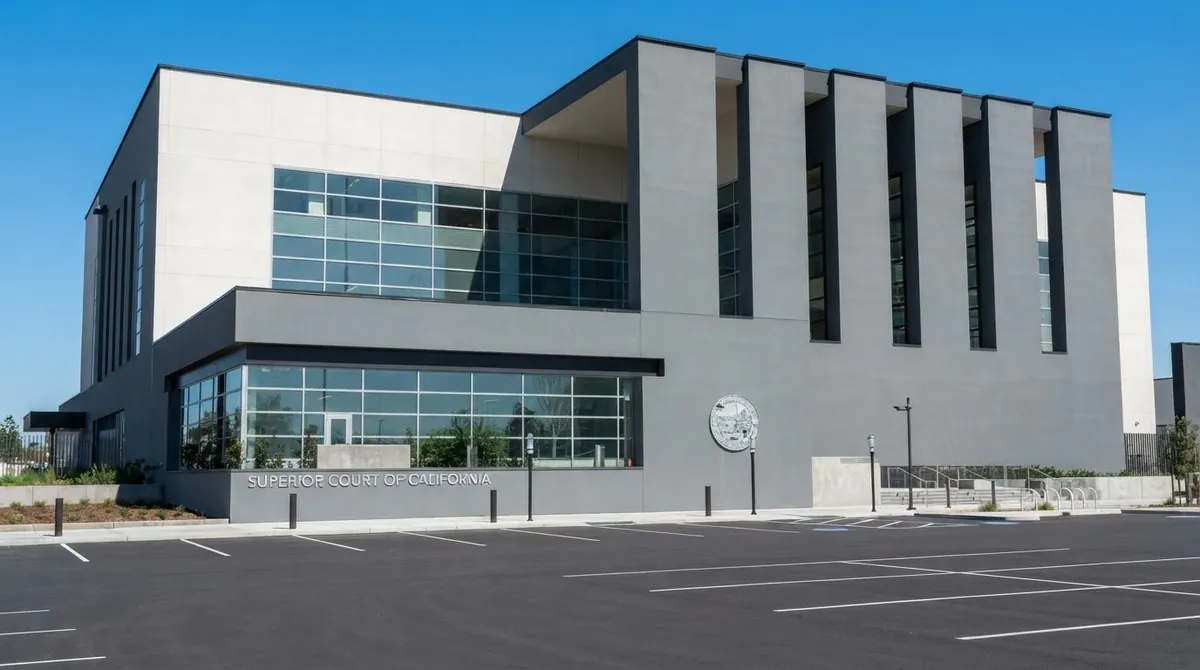
Court records for Sutter County, California, are maintained by the Clerk's Office of the Superior Court of the county and are accessible through online tools, official court portals, and directly at the court clerk's office. SutterCourt.us will help you find publicly available information about court cases in this county. Additionally, you can use the online case access portal of the Superior Court, submit a records request, or visit the clerk's office in person.
Sutter Court System Overview
Sutter County is served by the Superior Court of California, County of Sutter. In California, each county has a single Superior Court—a court of general jurisdiction that handles all categories of cases: criminal, civil, family, juvenile, and probate matters. Appeals from this court go to the Third Appellate District Court of Appeal, located in Sacramento. The court operates in a single building—the Sutter County Superior Courthouse.
The official court website provides information on remote participation in hearings, jury status, court schedules, and other services.
Courts Serving Sutter
State Superior Court
U.S. District Court
Sutter County falls under the jurisdiction of the U.S. District Court for the Eastern District of California. The nearest branch is located in Sacramento.
U.S. Bankruptcy Court
There are no municipal courts in Sutter County—all municipal courts in California were consolidated with county superior courts in 1998.
What Types of Cases Sutter Courts Hear
The Superior Court of Sutter County hears virtually all types of cases that arise at the state level. Here are the main categories:
- Criminal cases: felonies, misdemeanors, infractions
- Civil lawsuits: general civil cases, small claims cases
- Family law: divorce, child custody, child support, paternity
- Probate: estate administration, guardianship, conservatorship
- Juvenile cases: child protection, adoption
- Traffic violations and DUI cases
District Court Cases in Sutter
California does not have a separate district court at the state level—the Superior Court performs this function. It handles all felonies from start to verdict, civil cases without a claim limit, and appeals from small claims decisions. Cases are assigned to judges according to the court's internal rules. A criminal case begins with an indictment or a complaint from the district attorney, followed by an arraignment where the defendant enters a plea. More details about the criminal division of the court can be found on the official website.
Magistrate Court Cases in Sutter
California does not have separate magistrate courts at the state level. Instead, the Superior Court handles cases that in other states fall under the jurisdiction of magistrate judges:
- Misdemeanors and infractions, including traffic violations
- DUI cases—from arraignment to sentencing
- Small claims cases with a claim amount up to $10,000 for individuals
- Limited civil cases with a claim amount up to $25,000
Traffic violations can be contested through the court's online portal, where information about traffic school and options for contesting fines is also available. Small claims cases do not require an attorney—parties represent themselves.
Family Law, Probate, and Juvenile Matters in Sutter
Family Law
Divorce, custody, child support, protective orders, and paternity are handled by the Superior Court of Sutter County. The court's Self-Help Center conducts divorce clinics to assist with completing necessary forms. This is a free service.
Probate
Cases involving the administration of deceased estates, conservatorship of adults, guardianship of minors, and trust disputes are handled by the same Superior Court. Standard California Judicial Council forms are used for filing petitions.
Juvenile Matters
Juvenile dependency and delinquency cases are confidential. Access to records is restricted—usually only the parties involved and their attorneys can view the documents. The court provides information on remote participation in juvenile hearings.
How Cases Move Through the Sutter Court System
- Filing a complaint or petition. A criminal case starts with a prosecutor's complaint; a civil case begins with filing a complaint or petition with the court clerk.
- Assignment of a judge. The clerk's office assigns the case to a specific judge according to the court's internal rules.
- First hearing. In criminal cases, this is an arraignment where charges are read. In civil cases, it's a case management conference.
- Pre-trial phase. Parties exchange evidence (discovery) and file motions. In criminal cases, plea bargaining may occur.
- Trial or settlement. The case concludes with a trial, settlement, or plea agreement.
- Post-judgment. Sentencing in criminal cases, enforcement of judgment in civil cases. Parties may appeal to the Third District Court of Appeal.
Court Administration, Local Rules, and Public Access in Sutter
The Superior Court of Sutter County is headed by the Presiding Judge, and administrative work is coordinated by the Court Executive Officer. Local forms and rules are available on the court's website, and statewide Judicial Council forms are available on the California Courts portal.
Most court records in California are public according to Judicial Council rules on public records access. Exceptions include:
- Juvenile cases—confidential
- Sealed cases
- Records restricted by court order
- Certain family cases with limited access
Hearings can be attended in person or remotely. The court provides information on remote participation in criminal, civil, family, and juvenile cases on its website.
A fee of $15 per name is charged for archived cases (prior to 1994) according to GC 70627(c) if the search takes more than 10 minutes. Fill out the online records request form or visit the clerk's office in person.
Court Records and Related Court Resources in Sutter
- Online case search. The online case access portal allows you to check the status of current and completed cases in the Superior Court of Sutter County.
- Records request. Through the records request page, you can order document copies by providing the case number or party name.
- Local forms and self-help. Download local court forms or use the Self-Help Center for guidance.
- Vital records. Birth, death, marriage, and divorce certificates are maintained by the California Department of Public Health (CDPH-VR).
- Inmate search. The CIRIS (California Incarcerated Records & Information Search) system allows you to find individuals under CDCR supervision.
- Record clearing. While full expungement is not available in California, there are options for clearing records—more details on the California Courts self-help portal.
- Criminal history. Request to review your own criminal history through the California Attorney General's Office.
- Crime statistics. The California Department of Justice data portal contains statistics and information from criminal justice databases.
- State portal. Statewide services and resources are available on the official California portal CA.gov.
To search for publicly available information about court cases in Sutter County, you can also use SutterCourt.us.